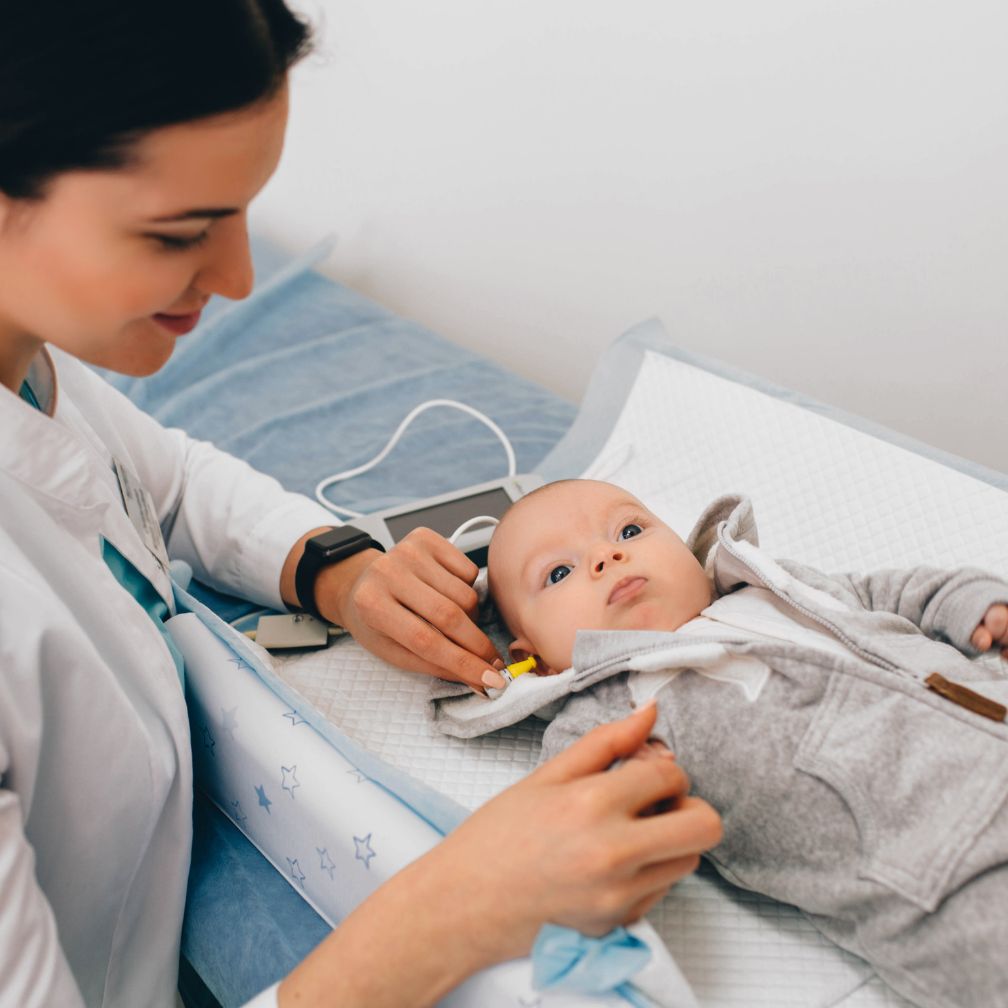
For mothers and fathers with newborns, learning that their baby has hearing loss will feel overwhelming and disheartening. Yet the optimistic truth is that via rapid screening and support, young children facing auditory deficits routinely attain profound developmental success. Beyond question, such babies can gain verbal communication, expressive ability, and strong bonds within their surroundings, unlocking a highly enriched future!
Combining external hearing aids with targeted cochlear implantation yields two outstanding clinical approaches for assisting infants with hearing loss. Down below, we investigate their mechanisms of action to help you decide which option best serves your youngster.
Understanding Infant Hearing Loss
Hearing impairment in young infants can trace back to multiple potential origins, including:
- Random genetic variations (even across lineages lacking hearing loss history)
- Primary maternal congenital infections like cytomegalovirus (CMV) or rubella infection
- Birth-related trauma, such as neonate oxygen loss or premature delivery
- Specific therapeutic drugs given inside hospital neonatal intensive units
The single most critical action? Swift diagnostic evaluation. This clinical standard explains why newborns across the United States undergo auditory checks prior to leaving the birth facility. Certified pediatric audiologists active execute the recognized “1-3-6” care benchmark:
- Baseline screening performed before 1 month of life
- Definitive hearing diagnosis established by 3 months of age
- Medical intervention (incorporating corrective units or speech habilitation) established inside 180 days post-birth
Reaching these early milestones offers infants optimal opportunities for healthy speech, language, and brain development. Should you need direction about these testing stages, your pediatrician will gladly offer support!
Pediatric Hearing Aids for Young Babies
For young children showing mild to severe auditory impairment, digital hearing aids routinely constitute the preferred initial approach. These miniature, wearable instruments boost incoming sound waves, assisting babies in catching spoken words and environmental sounds more distinctly.
Current pediatric hearing aids function as:
- Fully safe for direct use on newborns only a few weeks after birth
- Constructed using pliable, soft ergonomic molds that change as the child grows
- Furnished with child-proof battery covers and specialized pediatric safety components
- Uniquely calibrated by a specialized pediatric audiologist to mirror your infant’s unique auditory curve
As your baby grows, hearing aids necessitate regular clinical recalibrations to ensure snug placement and precise amplification.
Cochlear Implants for Infants
When a baby presents with severe to profound sensorineural impairment that shows insufficient improvement with standard hearing aids, specialists routinely suggest a cochlear implant. Unlike conventional amplification tools, cochlear implant systems:
- Entail precision surgical insertion inside the inner ear delivering direct electrical signals to the brain
- Completely bypass compromised regions inside the inner ear anatomy
- Transform acoustic energy into electrical impulses that activate the hearing nerve directly
Dedicated pediatric cochlear devices serve as:
- Officially FDA-sanctioned for infants aged 9 to 12 months
- Highly successful when supported through early developmental habilitation and consistent family involvement
- Prescribed solely following an exhaustive clinical assessment by an expert audiologist and ENT specialist
Such a comprehensive process requires temporal bone imaging, objective hearing assessments, and setting realistic expectations for future communicative success.
Comparing Hearing Aids and Cochlear Implants: Key Differences
- Mild to severe hearing challenges suit Hearing Aids; Severe to profound levels of loss demand Cochlear Implants
- Non-Invasive acoustic positioning: Hearing Aids; Invasive surgical installation: Cochlear Implants
- Physical sound amplification: Hearing Aids; Direct conversion to electrical signals: Cochlear Implants
- Fitting starts at early infancy: Hearing Aids; Access starts at 9-12 months: Cochlear Implants
Hearing Aids vs. Cochlear Implants: Final Thoughts
Should your baby receive a formal hearing loss diagnosis, rest assured that clear options and compassionate guidance. By partnering with skilled pediatric auditory specialists, countless infants successfully cultivate communication skills that mirror those of their age group.
Whether your baby benefits most from custom hearing aids or a cochlear implant system, early action establishes a foundation for lifelong communicative success.
Are you looking for clarity regarding your infant’s hearing development? Call our clinic today to schedule a thorough assessment and individualized management strategy.