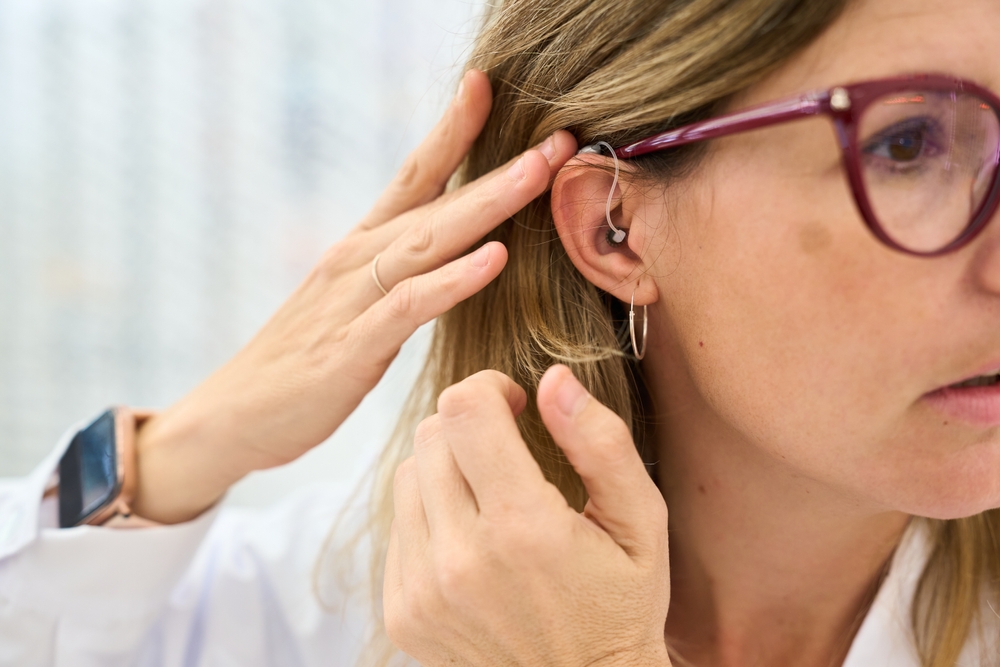
A primary reason individuals put off addressing auditory deficits is the assumption that assistive devices will be unsightly or awkward to wear. And that’s completely understandable! Regrettably, some people even experienced social alienation because acquaintances falsely assumed that wearing a visible aid signaled a complete inability to comprehend spoken dialogue.
This obsolete perception remains deeply embedded in the public consciousness, creating a massive barrier to proactive treatment. The liberating truth is that twenty-first-century auditory tech offers a level of cosmetic elegance and physical comfort that surprises most patients. Ongoing innovations in cosmetic engineering mean today’s options are ultra-small, seamlessly comfortable, and beautifully hidden from public view.
If cosmetic anxiety has caused you to delay treating your hearing loss, it is highly recommended that you evaluate the sophisticated options now available.
The Hearing Aid You’re Picturing Doesn’t Really Exist Anymore
When asked to visualize a hearing instrument, the average person still envisions an awkward, highly conspicuous piece of hardware visible from yards away. If that’s the case, you’re thinking about hearing aids circa the 1980s and ’90s.
In the intervening decades, the entire field of otolaryngology and acoustic engineering has undergone a massive paradigm shift. Continuous refinements in ergonomic styling, nanometer-scale circuitry, and digital audio engineering have radically overhauled the modern cosmetic profile. The resulting devices are beautifully downsized, highly aerodynamic, and built to match lifestyle needs by remaining completely hidden.
A substantial percentage of contemporary options reside deep within the auditory canal, ensuring absolute invisibility during routine face-to-face interactions. Different configurations sit comfortably behind the ear but feature such a low profile and featherweight build that observers naturally miss them.
A Taxonomy of Modern Styles: From Totally Hidden to Ultra-Streamlined
If you are curious about the structural choices available for your rehabilitation, here is an accessible overview of current styles:
Invisible-in-Canal (IIC) Technology
For total subtlety, these instruments have no medical equal. IIC devices sit completely inside the ear canal and are custom-made to fit your ear. From a normal conversational distance, they’re essentially invisible. They’re a popular choice for people with mild to moderate hearing loss who prioritize subtlety.
Receiver-in-canal (RIC) / Receiver-in-the-ear (RITE)
Statistically, this open-fit design represents the dominant choice among current consumers. A micro-housing rests behind the upper pinna, transferring processed sound via an ultra-fine, translucent micro-wire to an acoustic driver nestled inside the canal. To a casual observer, their clean lines often mimic high-end commercial wireless earbuds. Surrounding individuals will remain completely unaware of the technology unless they actively look for it.
Behind-the-ear (BTE)
While these models house all electronic components within a casing resting behind the pinna, their dimensions are drastically reduced compared to legacy models. Frequently utilized to remediate severe-to-profound auditory loss, they maximize gain and processing capability while maintaining a highly professional, low-profile aesthetic.
Ultimately, contemporary hearing aids are built to empower your daily routine rather than broadcast a medical condition to the world.
Modern Hearing Aids: Looking Better and Doing a Lot More
The recent metamorphosis of hearing instruments extends far beyond mere cosmetic downsizing. Contemporary devices are essentially miniature smart hubs rather than historical medical hardware. Many variants integrate high-speed Bluetooth protocols, allowing you to route phone calls, podcasts, or multimedia audio straight to your ears without external headphones.
Equipped with dedicated smartphone applications, they allow users to manipulate volume matrices or toggle environmental programs without making manual physical adjustments. Say you’re walking into a noisy restaurant: You can fine-tune your hearing to match the environment in seconds. Advanced rechargeable battery banks have effectively replaced the small, fragile power cells that used to cause immense frustration. Users simply place their instruments into a charging cradle before sleep, mirroring standard smartphone maintenance routines.
Getting Over the Fear and Stigma of Hearing Devices
Despite being aware of these massive design improvements, it is entirely normal to feel a sense of hesitation. Scheduling an appointment can feel like a profound internal challenge because it represents an open admission of sensory alteration. This mental hurdle can make an individual feel exposed, creating a false impression of losing authority over personal wellness.
But here’s a different way to look at it: Hearing aids aren’t a sign that something has gone wrong. They are simply tools for managing standard lifecycle changes, which are a normal part of the human experience. Investing in your hearing shows that you are actively deploying advanced resources to support your systemic well-being and social connection.
Picture yourself wearing an ultra-low-profile, virtually invisible instrument that allows you to effortlessly decode rapid speech, thrive in complex soundscapes, and re-engage with your favorite hobbies. Talk about empowering!
See For Yourself What Today’s Hearing Aids Look Like
The quickest way to erase your grandfather’s mental model is to physically interact with twenty-first-century hearing tech. We warmly welcome you to tour our practice, consult with our audiologists, and review our product lines with absolutely no financial or purchase obligations. View this consultation simply as a tactile opportunity to discover just how radically changed this technology has truly become.
The overwhelming majority of our patients leave their consultation thoroughly amazed by the compact scale, luxurious comfort, and acoustic clarity of current technology! Please contact our patient care coordinators or utilize our digital portal to secure your consultation this week.